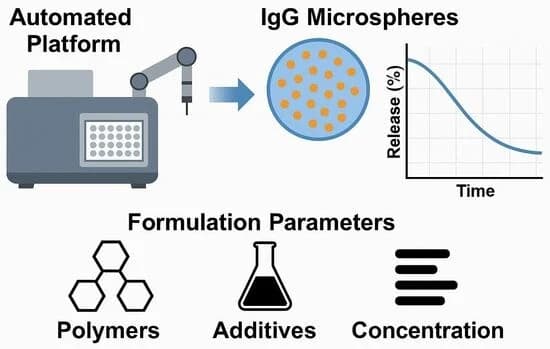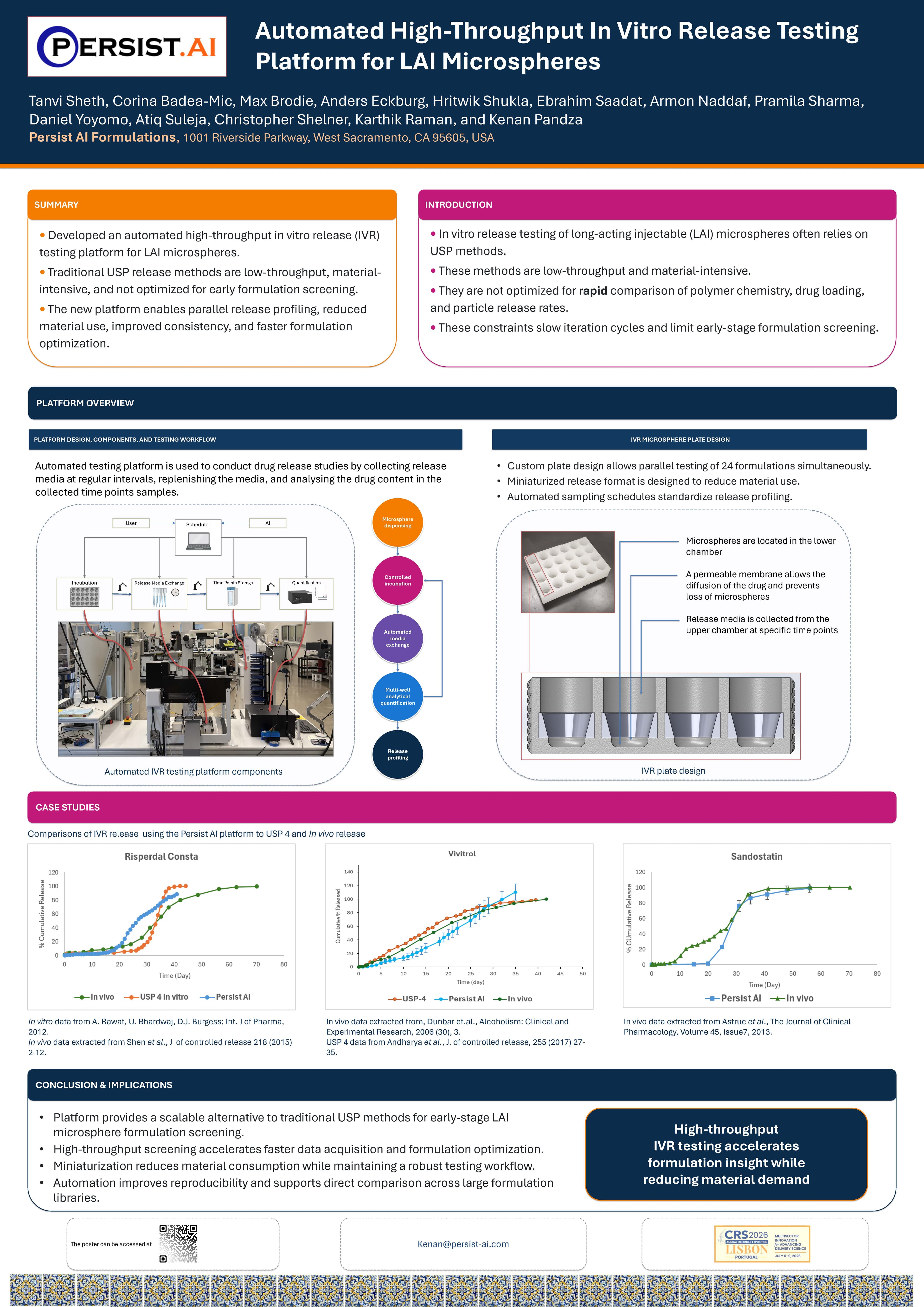

Pharmaceutical formulation refers to the development of drug delivery systems aimed at optimizing drug stability, efficacy, and safety by incorporating active pharmaceutical ingredients (API) and other necessary components. Formulation plays a pivotal role in the drug development pipeline, enhancing treatment effectiveness, reducing dosing frequency, and enabling targeted drug delivery.
Long-acting injectables (LAIs) are a specialized type of formulation designed for extended drug release, offering benefits like improved patient compliance and cost-effectiveness. Microsphere formulations, using microencapsulation techniques, are crafted from biodegradable polymers and can be used for LAIs. They provide the advantage of customizable drug release rates. In-situ depot (ISD) LAI formulations, on the other hand, create a reservoir at the injection site to facilitate sustained drug release through methods like polymer precipitation and sol-gel transition. These diverse formulation approaches collectively contribute to the creation of safe and effective drug products, enhancing the well-being of individuals.
Pharmaceutical Formulation
Pharmaceutical formulation refers to the process of developing a dosage form or drug delivery system that contains the active pharmaceutical ingredient (API) along with other excipients. The aim involves optimizing drug delivery while ensuring stability, efficacy, and safety through appropriate excipient selection, dosage form determination, and specialized design for controlled or targeted delivery.
How Pharmaceutical Formulations Help People
Pharmaceutical formulations optimize medication effectiveness by enhancing stability and bioavailability of drugs, allowing for sustained release over an extended period. Benefits include improved treatment efficacy, reduced dosing frequency, enhanced patient convenience, and enabled targeted delivery to specific body sites for particular diseases or conditions.
Pharmaceutical Formulation in Drug Development Pipeline
Formulations are typically developed after the discovery and characterization of a drug compound. They encompass excipient selection, dosage form determination, and product formulation ensuring stability, efficacy, and safety—translating drug candidates into viable products for manufacturing, testing, and patient administration.
Types of Pharmaceutical Formulations
Pharmaceutical formulations are produced in many forms including:
- Solid dosage forms: Tablets, capsules, and powders where API mixes with excipients and compresses into solid form.
- Liquid dosage forms: Solutions, suspensions, and emulsions where API dissolves or disperses in liquid medium.
- Semi-solid dosage forms: Creams, ointments, and gels incorporating API into semi-solid bases.
- Parenteral dosage forms: Injections, infusions, and implants administered intravenously, intramuscularly, or subcutaneously.
- Inhalation dosage forms: Aerosols, inhalers, and nebulizers delivering API to the respiratory system.
What Are Long Acting Injectables (LAIs)?
Long-acting injectables (LAIs) are advanced drug delivery systems designed to release drugs over an extended period, providing a prolonged therapeutic effect. They offer improved patient compliance and bioavailability. LAIs can be engineered for either local targeting specific sites or systemic release into bloodstream circulation.
Development gains significance for enhancing long-term bioavailability and treatment efficacy. Prolonged drug exposure can improve safety and efficacy by reducing administration frequency while ensuring consistent therapeutic effects—particularly beneficial for chronic diseases requiring continuous drug exposure. LAIs can also decrease healthcare costs through reduced provider visits and improved outcomes.
Formulation involves complex physico-chemical processes requiring stringent control over extended release behavior. Recent advances in machine learning show promise in predicting experimental drug release, potentially reducing development time and costs.
LAIs enable using APIs with dose-limiting toxicity or rapid clearance while enhancing safety, convenience, efficacy, or adherence of existing products. However, development depends on pharmacokinetics, pharmacodynamics, therapeutic area, and patient population factors.
Microsphere Formulations
What Are Microsphere Formulations?
Microsphere formulations are drug delivery systems that consist of small spherical particles made of biocompatible and biodegradable polymers such as polylactide-co-glycolide (PLGA) and polylactic acid (PLA). These encapsulate proteins, peptides, or other biologically active substances. Advantages include customizable drug release rates, improved stability compared to liposomes, and enhanced compliance through reduced dosing frequency. Release kinetics depend on particle size, surface morphology, inner structure, and drug-polymer physicochemical properties.
How Do You Make Microspheres?
Common manufacturing methods include:
- Double emulsion solvent evaporation (most common): Creates water-in-oil-in-water emulsion encapsulating drug in internal water phase, mixed with polymer solution, evaporating solvent to form solid microspheres.
- Phase separation-coacervation: Polymer and drug dissolve in common solvent; phase separation induced by temperature or pH changes creates coacervate droplets, solidified into microspheres.
- Spray drying: Atomizing drug-polymer solution into fine droplets, dried with hot air or gas, collected as microspheres.
- Gelation and lyophilization: Converting microspheres into porous particles by incubating in suitable solution like chitosan hydrochloride, then freeze-drying.
- Suspension polymerization: Insoluble polymers solubilized in monomer solution containing nonpolar active components, dispersed in aqueous phase with surfactant, polymerized via temperature, irradiation, or catalyst, forming microspheres.
In-Situ Depot (ISD) Formulations
What Are ISD Formulations?
In-situ depot formulations refer to drug delivery systems that are designed to form a depot or reservoir at the site of injection. Administered as liquid or gel-like solutions undergoing phase transition upon injection to form solid or gel depots within the body, serving as drug reservoirs enabling sustained release over extended periods.
How Do You Make In-Situ Depot Formulations?
Common approaches include:
- Polymer precipitation: Polymer dissolves in solvent; upon body injection, solvent diffuses out, precipitating polymer and forming solid or gel depot.
- Sol-gel transition: Polymers undergo sol-gel transitions when exposed to specific environmental conditions like temperature, pH, or ion concentration, transforming liquid solution into gel or solid depot post-injection.
- Crosslinking: Chemically or physically linking polymer chains forming three-dimensional networks serving as sustained drug release depots.
Benefits and Limitations of Microsphere and ISD Formulations
Each formulation approach offers a distinct trade-off between manufacturing complexity, release kinetics, stability, and patient experience. Selecting the right system depends on the molecule, the indication, and the target product profile.