Abstract
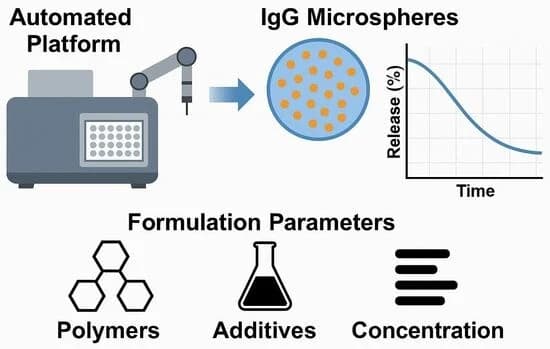
Background/Objectives: PLGA/PLA microspheres are attractive candidates for depot delivery of protein therapeutics, but formulation development for antibodies remains challenging because protein encapsulation, burst release, stability, and polymer composition must be balanced across a large design space. This study evaluated an automated high-throughput formulation workflow for preparing and screening IgG-loaded pegylated PLGA/PLA microspheres, with emphasis on loading and early release behavior.
Methods: Microspheres were prepared using an automated W/O/W emulsion workflow consisting of primary emulsion formation, microfluidic secondary emulsification, solvent removal, washing, and lyophilization. A formulation library was generated by varying polymer chemistry, polymer concentration, polymer blends, IgG concentration, and additives. Formulations were evaluated for IgG loading and in vitro release over the first 7 days using automated sampling and protein quantification. Statistical analyses were used to identify formulation variables associated with loading, burst release, day-7 release, and Weibull-derived kinetic descriptors.
Results: Across 129 formulations, IgG loading was generally in the low-to-mid single-digit percentage range. Additive class and IgG concentration in the dispersed phase were the formulation variables most strongly associated with early release behavior. Additive-free systems were associated with lower burst release, whereas non-polymeric additives were associated with higher burst and faster early release. Day-7 release differences were less robust after correction for variance heterogeneity and resampling.
Conclusions: The automated workflow enabled rapid preparation and comparative screening of IgG-loaded PLGA/PLA microspheres. The findings support the use of high-throughput automated screening to identify formulation variables associated with burst modulation and early release behavior. Because release was evaluated over 7 days and only one model IgG was used, the results should be interpreted as an early-stage formulation screening study rather than definitive evidence of long-term antibody depot performance.